
Showing posts with label bodybuild. Show all posts
Showing posts with label bodybuild. Show all posts
Sunday, 5 March 2023

Monday, 20 October 2014
If I Could Only do 5 Exercises....
1. SQUAT - The best lower body exercise. Nuff said!
2. DEADLIFT - The best exercise for overall posterior development. Hamstrings/glutes/lower back/abs/lats, rhomboids and traps/forearms. Massive exercise, must be included.
3. INCLINE DUMBELLS - Hits the chest hard and shoulders (varies depending on the % of incline) therefore more bang for your buck. Much prefer this movement to decline work.
4. WEIGHTED CHINS (close grip) - Best exercise for the lats. Heavy chins gives you wings!!!...and a hefty pair of biceps to match.
5. CLOSE GRIP BENCH - BIG tricep exercise as well as hitting the chest. Large triceps will do more for arm thickness than biceps.
Natural Aesthetics - Dream and Achieve
Tuesday, 14 October 2014
IS SQUATTING AN ABSOLUTE NECESSITY IN BODYBUILDING?

The question refers to whether or not the Barbell Back Squat is an absolute essential exercise for BODYBUILDING. Note the use of the word 'bodybuilding'; training purely for aesthetics. This is not in regards to strength training or powerlifting s the answer would be ENTIRELY the opposite.
For aesthetic purposes only, the squat is not essential. If you were to train your lower body HARD, smart and consistently for years without touching the squat rack you would more than likely have a decent set of legs. Heavy leg press, extensions, curls and lunges are great tools to build thigh mass - do these for long enough and hard enough and results will come. Aesthetically, its not the end of the world if you don't squat.
However, results would be FAR greater if squats were trained (properly/full depth) regularly with other lower body exercises or even as a replacement to all other lower body exercises. That's how good an exercise it is. I know I sound like I'm contradicting myself, but bear in mind the question is wether they are an absolute necessity for leg development. Leg muscles grow without squats, but you would be foolish to leave squats out of your routine knowing that they would produce far greater results in overall leg mass than any other exercise. I had decent legs a few years ago and my squatting was poor, infrequent and the technique inadequate. My legs were muscular from training HARD on exercises like lunges, leg press and extensions. The last 2 1/2 years or so I have focused mainly on progressing the squat for lower body training and subsequently my legs are bigger than ever.
As a natural trainee aiming to develop serious muscle mass - strength and it's progression must be considered. Simply pumping light weights with no regard to progression of reps, sets, weight or intensity variables will not yield the results commonly seen by trainers using steroids. The squat is the key exercise in the development of lower body strength and strength progression is the catalyst for any natural bodybuilders muscular development.
Although we can build lower body muscle without the back squat, progression will be far greater if heavy back squats are included in your routine regularly - especially for NATURAL trainers where strength progression is so key (but not the only way) to increased muscular development.
Although we can build lower body muscle without the back squat, progression will be far greater if heavy back squats are included in your routine regularly - especially for NATURAL trainers where strength progression is so key (but not the only way) to increased muscular development.
Any questions, OR ONLINE TRAINING enquiry's email me at rossi01@hotmail.co.uk
Facebook - www.facebook.com/naturalaesthet1cs
Youtube - www.youtube.com/naturalaestheticstv
Natural Aesthetics - Dream and Achieve
Monday, 22 September 2014
HOW TO MAKE CONSISTENT PROGRESS IN THE GYM.
Food for thought hear guys; just a really quick article regarding training progression and why most people do not achieve the results they want.
The top graph in the diagram depicts the progress 95% of gym goers see. After their initial gains in strength/muscularity from the body adapting to new loads (starting training) they will generally stall and fail to make any headway. They have no plan, do not track performance or variables and thus have no idea what to do to improve. They train MINDLESSLY, hopping from exercise to exercise, seeking out the pump.
The second graph shows a linear approach to training - in that progress is attempted each and every session. These guys have a plan and train hard to try and reach their goals but fail to understand that progress cannot be made continually. This works, to a point; until injuries start building up, fatigue sets in, demotivation perhaps and plateaus. This, combined with the first graph was how I trained for many years. Poor exercise form/chronic muscle tightness on key exercises as well as an inability to back down lead to plateaus and injuries.
The third chart represents the few trainers who understand patience is key to making consistent progress. Periods of intense, heavy training are followed by periods of lighter training to help the body recover and enable continued progress to be made once the intensity rises again. This can be called 'periodization' and is the best way to train for the longest without encountering injuries. Progress may be slow, but consistent. This is the phase of training I'm moving into now and I urge you to follow!

Ross Newham - Natural Aesthetics
www.youtube.com/naturalaestheticstv
www.facebook.com/naturalaesthet1cs
DREAM AND ACHIEVE
The top graph in the diagram depicts the progress 95% of gym goers see. After their initial gains in strength/muscularity from the body adapting to new loads (starting training) they will generally stall and fail to make any headway. They have no plan, do not track performance or variables and thus have no idea what to do to improve. They train MINDLESSLY, hopping from exercise to exercise, seeking out the pump.
The second graph shows a linear approach to training - in that progress is attempted each and every session. These guys have a plan and train hard to try and reach their goals but fail to understand that progress cannot be made continually. This works, to a point; until injuries start building up, fatigue sets in, demotivation perhaps and plateaus. This, combined with the first graph was how I trained for many years. Poor exercise form/chronic muscle tightness on key exercises as well as an inability to back down lead to plateaus and injuries.
The third chart represents the few trainers who understand patience is key to making consistent progress. Periods of intense, heavy training are followed by periods of lighter training to help the body recover and enable continued progress to be made once the intensity rises again. This can be called 'periodization' and is the best way to train for the longest without encountering injuries. Progress may be slow, but consistent. This is the phase of training I'm moving into now and I urge you to follow!

Ross Newham - Natural Aesthetics
www.youtube.com/naturalaestheticstv
www.facebook.com/naturalaesthet1cs
DREAM AND ACHIEVE
Tuesday, 16 September 2014
INTERVALS, EPOC AND WHY THEY ARE GOOD FOR FAT-LOSS
First, lets define EPOC: Excessive PostExercise Oxygen Consumption, or simply, recovery oxygen consumption. Following exercise, the body does not immediately return to resting levels. Light, short duration activity, which causes little disruption in body temperature and hormonal balance, is followed by rapid recovery, almost unnoticed. Of course what's classed as'light' exercise depends on the physical condition of the individual, for instance, an overweight person whom is unused to any considerable amount of exercise or even movement, will not recover as quickly doing the same activity as someone who is generally better prepared for physical exertion. One half of the total oxygen recovery consumption will occur within 30 seconds and total recovery within 4-7 minutes, this is known as the fast component in recovery oxygen consumption.
On the other hand, stressful exercise such as completing 20 back squats nearing muscular failure, or running 400m as quickly as possible will require considerable time for resting metabolism to occur (slow component). The length and the intensity of exercise will determine how long this takes; research has shown this can take as long as 24 hours for the body to return back to baseline oxygen consumption levels (McArdle, Katch and Katch, 2007). To reiterate, a considerably greater oxygen debt will be placed upon the body following strenuous exercise. This means that the body will utilise more oxygen (Litres) in an attempt to return to pre-exercise oxygen consumption.
Why does the body need so much oxygen following exhaustive exercise (where the activity requires a significant anaerobic component as well as aerobic)? There are a few factors that contribute to EPOC; a small part of it is used to aid re-synthesis of lactate to glycogen (although this is mostly the job of dietary carbohydrates - which is a good thing for fat loss). Elevated body temperature also contributes to EPOC. Temperature can rise by up to 3c during exhaustive exercise and can remain elevated for hours after the exercise. This stimulates metabolism to increase oxygen consumption during recovery. Natural Fat burners guys...
Up to 10% of of recovery oxygen will be used to take the blood from the trained muscles back to the lungs, as well as the restoration of oxygen lost via bodily fluids and that which is bound to myoglobin in the active muscles. Ventilation volumes remain elevated, the heart works harder and requires greater oxygen supply during prolonged recovery, tissue repair and redistribution of key minerals and ions and the residual thermogenic hormones relaesed during exercise all go towards keeping metabolism elevated during EPOC.
In summary, after prolonged strenuous aerobic or exhaustive anaerobic activity the body requires more oxygen for considerable lengths of time to recover. This means a potential greater kcal expenditure during EPOC, rather than just kcal expended during exercise, something which can make weight management easier for everyone.
However, attempting to train at the intensity and duration required to induce said EPOC is difficult. Extreme intensity is necessary, something which trainees need time to work up to. Imagine performing 20 back squats with a weight you would usually do 10, or a cross country race for for a 5 second pb, or perhaps 2 minutes worth of clean and press with a 70%1rm followed by 50 burpees. Extreme pain comes to mind. This is where intervals can become very useful. Shorter (supermaximal) bouts of exercise, intermittently spaced between rest periods, can produce substantial recovery oxygen consumption for well over an hour (McArdle, Katch and Katch, 2007).
An exercise that when performed continuously would normally cause exhaustion within several minutes can be split up into intermittent segments of work and rest periods. By structuring the workout in such a way a much greater volume of workload can be achieved thus overloading the energy transfer system. Exercise up to 8 seconds (all-out intensity) relies on intramuscular phosphates to provide the majority of the energy. Due to quicker recovery and lower blood lactate levels, intense exercise can follow after a brief recovery period. Total work volume over a session can increase using interval training. Christenson EH, et al. found that by adding a 5 second rest period to every 10 second of running the athlete improved the total distance ran by nearly 5 times that of the distance ran at a continuous speed before exhaustion.
Total Distance run (yards) for 4 min of continuous (until exhaustion) - 1422
Total Distance run (yards) for 10s exercise/5s rest - 7294
{Same speed for both days)
Intervals are a fantastic tool for increasing workload, past the point one would usually fail at if exercising continuously. This means greater kcal expenditure and potentially better weight management. Think twice before you jump on that treadmill and half ass that 5km. Utilize full body weight lifting movements within your intervals (squat thrusters/clean and press etc.) to produce the physiological adaptations associated with weight bearing movements (increased muscle mass/strength etc.) AND burn substantial kcal during and after exercise!
Ross - Natural Aesthetics
www.youtube.com/naturalaestheticstv
www.facebook.com/naturalaesthet1cs
On the other hand, stressful exercise such as completing 20 back squats nearing muscular failure, or running 400m as quickly as possible will require considerable time for resting metabolism to occur (slow component). The length and the intensity of exercise will determine how long this takes; research has shown this can take as long as 24 hours for the body to return back to baseline oxygen consumption levels (McArdle, Katch and Katch, 2007). To reiterate, a considerably greater oxygen debt will be placed upon the body following strenuous exercise. This means that the body will utilise more oxygen (Litres) in an attempt to return to pre-exercise oxygen consumption.
Why does the body need so much oxygen following exhaustive exercise (where the activity requires a significant anaerobic component as well as aerobic)? There are a few factors that contribute to EPOC; a small part of it is used to aid re-synthesis of lactate to glycogen (although this is mostly the job of dietary carbohydrates - which is a good thing for fat loss). Elevated body temperature also contributes to EPOC. Temperature can rise by up to 3c during exhaustive exercise and can remain elevated for hours after the exercise. This stimulates metabolism to increase oxygen consumption during recovery. Natural Fat burners guys...
Up to 10% of of recovery oxygen will be used to take the blood from the trained muscles back to the lungs, as well as the restoration of oxygen lost via bodily fluids and that which is bound to myoglobin in the active muscles. Ventilation volumes remain elevated, the heart works harder and requires greater oxygen supply during prolonged recovery, tissue repair and redistribution of key minerals and ions and the residual thermogenic hormones relaesed during exercise all go towards keeping metabolism elevated during EPOC.
In summary, after prolonged strenuous aerobic or exhaustive anaerobic activity the body requires more oxygen for considerable lengths of time to recover. This means a potential greater kcal expenditure during EPOC, rather than just kcal expended during exercise, something which can make weight management easier for everyone.
However, attempting to train at the intensity and duration required to induce said EPOC is difficult. Extreme intensity is necessary, something which trainees need time to work up to. Imagine performing 20 back squats with a weight you would usually do 10, or a cross country race for for a 5 second pb, or perhaps 2 minutes worth of clean and press with a 70%1rm followed by 50 burpees. Extreme pain comes to mind. This is where intervals can become very useful. Shorter (supermaximal) bouts of exercise, intermittently spaced between rest periods, can produce substantial recovery oxygen consumption for well over an hour (McArdle, Katch and Katch, 2007).
An exercise that when performed continuously would normally cause exhaustion within several minutes can be split up into intermittent segments of work and rest periods. By structuring the workout in such a way a much greater volume of workload can be achieved thus overloading the energy transfer system. Exercise up to 8 seconds (all-out intensity) relies on intramuscular phosphates to provide the majority of the energy. Due to quicker recovery and lower blood lactate levels, intense exercise can follow after a brief recovery period. Total work volume over a session can increase using interval training. Christenson EH, et al. found that by adding a 5 second rest period to every 10 second of running the athlete improved the total distance ran by nearly 5 times that of the distance ran at a continuous speed before exhaustion.
Total Distance run (yards) for 4 min of continuous (until exhaustion) - 1422
Total Distance run (yards) for 10s exercise/5s rest - 7294
{Same speed for both days)
Intervals are a fantastic tool for increasing workload, past the point one would usually fail at if exercising continuously. This means greater kcal expenditure and potentially better weight management. Think twice before you jump on that treadmill and half ass that 5km. Utilize full body weight lifting movements within your intervals (squat thrusters/clean and press etc.) to produce the physiological adaptations associated with weight bearing movements (increased muscle mass/strength etc.) AND burn substantial kcal during and after exercise!
Ross - Natural Aesthetics
www.youtube.com/naturalaestheticstv
www.facebook.com/naturalaesthet1cs
Sunday, 31 August 2014
6 COMMANDMENTS OF NATURAL MUSCLE GROWTH
1. EAT TO GROW! Feed your body the necessary calories required to add muscle. Your trying to gain weight; to add muscle tissue...this is not possible if your chronically under-eating. Rice cakes and chicken will not cut it 24/7.
2. INTENSITY IS EVERYTHING! Stop farting around and start training like its your job. 15 rep sets with a weight that you could do 25 reps with will not cause serious growth. Embrace pain - learn to love it!!
3. FOCUS ON WHATS IMPORTANT! Stop worrying about stuff that doesn't matter....how many meals are optimal/what type of carbs should one eat/how many sets should one do? Just DO something, its never going to be 100% optimal.
4. PATIENCE! Unless you have amazing genetics to build muscle its going to take years. Accept it and your training will benefit from that. Stop looking for a shortcut, supplement or a secret training formula that will get you to where you want quicker.....leave that for those who want to use drugs.
5. TRAIN HEAVY! To build a big natural physique your going to have to lift heavy! Ive never seen a BIG natural who trained with light weights exclusively. Include compounds lifts (multiple muscle movements; bench/deadlift/squat/overhead press/pullups and dips etc.) in your training. Focus on getting stronger over time on these lifts and they will act as a catalyst for your training and physique.
6. VARIETY ISN'T ESSENTIAL! Variety for the sake of it is far too common. Why change exercises when the basics have not been mastered. TOO much variety will hinder progress. Muscles do not need exercise surprises, bludgeon them into growth with variations of volume (how much training, sets and reps)/frequency (how many times per training cycle) and intensity (weight and or overload techniques) instead.

Ross - Natural Aesthetics
Friday, 9 May 2014
The Decline of Boybuilding and the art of Posing.
Its my humble opinion that the physiques of top tier bodybuilders have been getting worse since the 1990's. Mass is obviously the order of the day, but with little regard to shape, balance, aesthetics and quality of posing. Don't get me wrong, there are some fantastic physiques out there but it seems that for guys to push into the top tier (IFBB) they have to add so much mass to compete that it ruins the balance and aesthetics that made them good in the first place.
.png) |

There is far less emphasis on the athletes individual posing routines nowadays. Top IFBB bodybuilders nowadays cannot pose as well as the bodybuilders 30 years ago. This is not just because their heavily muscled physiques are not suited to many of the artistic poses but also because the judging doesn't seem to care for it or at least encourage it during shows. Kai Greene is an exception (he is a master in posing). Only the mandatory poses (essential) seem relevant now.
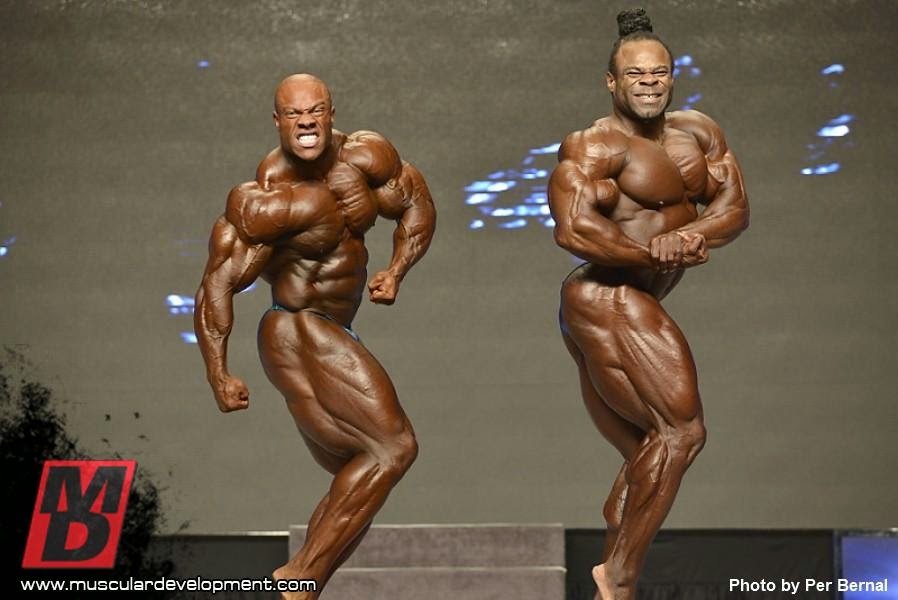
The increasing dosages of drugs, as well as the introduction of other drugs/compounds (namely HGH and insulin) have ruined top tier bodybuilding. The physiques are impressive; massive behemoths with striated glutes - yet very few of them can perform side poses that well and none of them can perform a vacuum (sucking your abs in to make the waist like tiny from the front/side). What is the point of having an extra 20kg of muscle on the frame but adding another 3+inches to the waist?! This destroys the purpose of having more muscle because it looks far less impressive!

Top tier bodybuilders nowadays seem to present a collection of fantastic body parts, rather than a flowing, strong entire physique. A lot of these athletes (not all of them) train mostly with machines now and it shows in their body shape and presentation. Unfortunately with the drugs available its clear that heavy, intense training with free weights isn't needed to build a massive physique when these compounds are used. Many top tier natural bodybuilders still train very heavy with mostly free weights and achieve fantastic results, whilst keeping a narrow waist!


Wednesday, 5 February 2014
CURRENT TRAINING PROTOCOL
Recently made a few subtle tweaks to my training program. I will continue this protocol for 5-6 weeks then go back to 4 day a week training to add more volume on bodyparts.
Day 1 - Front squats 5x5/Barbell row 5x5/Behind neck press 5x8/Upright rows 3x8 + Heavy arms (5-8reps)
Day 2 - Deadlift 5x5/Bench press 5x5/DB incline 5x5/Pullups 5x5/Hamsstring curls 5x8
Day 3 - Front squats 5x3/Barbell row 5x3/Behind neck press 5x5/Rear delt rows + Arms (8-12reps) and calves 10x10
Light cardio - 20 mins x4 pw

Subscribe to:
Posts (Atom)